
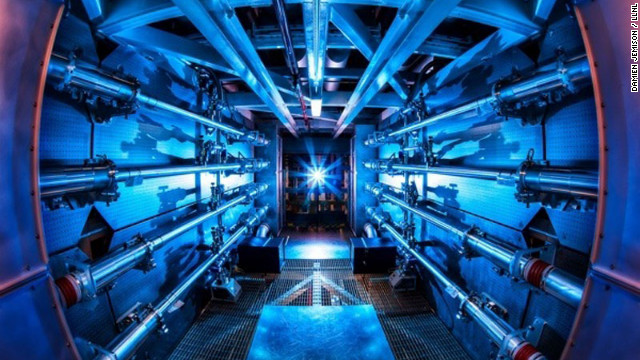
(Time.com) -- For all the heady talk about misleadingly "deific," recently confirmed quantum specks named after Scottish physicists, another kind of historic event just transpired: a record-shattering laser beam that, in a single shot fired on July 5, 2012, generated more power than the United States does at any single instant.
Spooky or astonishing?
How about both. Think of it as "extreme sports science," a kind of
lab-based game of automatic one-upmanship where researchers fiddle with
incredibly complex, painstakingly calibrated machinery to produce
unprecedented results -- then outdo them.
That's what the National Ignition Facility
-- home to the world's largest laser -- just did when it pulled the
trigger on 192 beams of optically amplified, electromagnetic
radiation-emitting light, all fired within a few trillionths of a second
of each other, to deliver 500 trillion watts (or terawatts) of "peak
power" and 1.85 megajoules of ultraviolet laser light.
Framed in more
eye-catching terms: The NIF says 500 terawatts outpaces the entire U.S.
for power used "at any instant in time," and that 1.85 megajoules
amounts to roughly 100 times what any other laser produces regularly. No
wonder those two power unit prefixes (tera, mega) come from Greek words
meaning "monster" and "great."
Then again, what else would you expect from a laser housed in a building the size of three football fields, or a science lab with a word like "ignition" in its moniker?
The NIF, located in
Livermore, California, came online in March 2009, and its goals are
manifold: Its primary mission, given funding by the National Nuclear
Security Administration (NNSA) -- "a semi-autonomous agency within the
U.S. Department of Energy responsible for enhancing national security
through the application of nuclear science to the nation's national
security enterprise" -- is to duplicate what happens in contemporary
nuclear weapons, in part to render underground nuclear testing
unnecessary.
But it's also a repository for scientists -- the same sort that poke around at sub-sub-atomic
levels for elemental quantum particles -- looking to understand
"extreme states of matter that exist in the centers of planets, stars
and other celestial objects."
And last but not least
-- well beyond the holster-loaded conventions of mere pulp sci-fi
skirmishing -- the NIF laser is about puzzling out something called
"fusion ignition": the point at which nuclear fusion reactions become
self-sustaining, to, in the NIF's words, "provide abundant and
sustainable clean energy."
Fusion reaction is
arguably the most exciting of the NIF's goals: to catalyze
self-sustaining nuclear fusion, wherein two light atomic nuclei "fuse"
together and produce a single heavier nucleus while converting some of
that mass to incredible amounts of energy. That, in so many words, is
how stars are born, and it's something scientists have been working to
achieve since the 1950s.
The 500-terawatt shot on
July 5 brings scientists closer to solving a longstanding physics
challenge and arguably the field's holy grail: getting back more energy
than you give.
"The 500 TW shot is an
extraordinary accomplishment by the NIF Team, creating unprecedented
conditions in the laboratory that hitherto only existed deep in stellar
interiors," said MIT physicist Dr. Richard Petrasso in a statement on the NIF's site.
"For scientists across the nation and the world who, like ourselves,
are actively pursuing fundamental science under extreme conditions and
the goal of laboratory fusion ignition, this is a remarkable and
exciting achievement."
The July 5 shot was
actually the NIF's third in a series of test fires, a series that's seen
power ramped up by nearly 100 terawatts since March 15, when the NIF
fired a shot that delivered 1.8 megajoules and peak power of 411
terawatts.
And while electricity
produced by sustained, controlled fusion reactions may not be
commercially viable, well, ever, depending whom you talk to -- some say
30 to 40 years; others say indefinitely given the technical challenges
of putting star-stuff in a container -- the July 5 laser shot appears to
be a major step forward.
"NIF is becoming
everything scientists planned when it was conceived over two decades
ago," said NIF Director Edward Moses of the July 5 shot. In January
2012, Moses predicted that fusion ignition would happen "in the next 6-18 months."
We're getting close, in other words, to what you might call "the end of the beginning" of the very long -- and expensive: an experimental international fusion reactor being built in France is said to cost 16 billion euros, or nearly US$20 billion -- road to theoretically limitless energy generation.
This article originally appeared on Time.com: The laser beam 1,000 times more powerful than the United States
